Artificial Intelligence workloads have evolved faster than gaming performance itself. From ChatGPT-like LLMs to Stable Diffusion and LLaMA, training and inference require massive parallel processing — and that’s where GPUs for AI dominate.
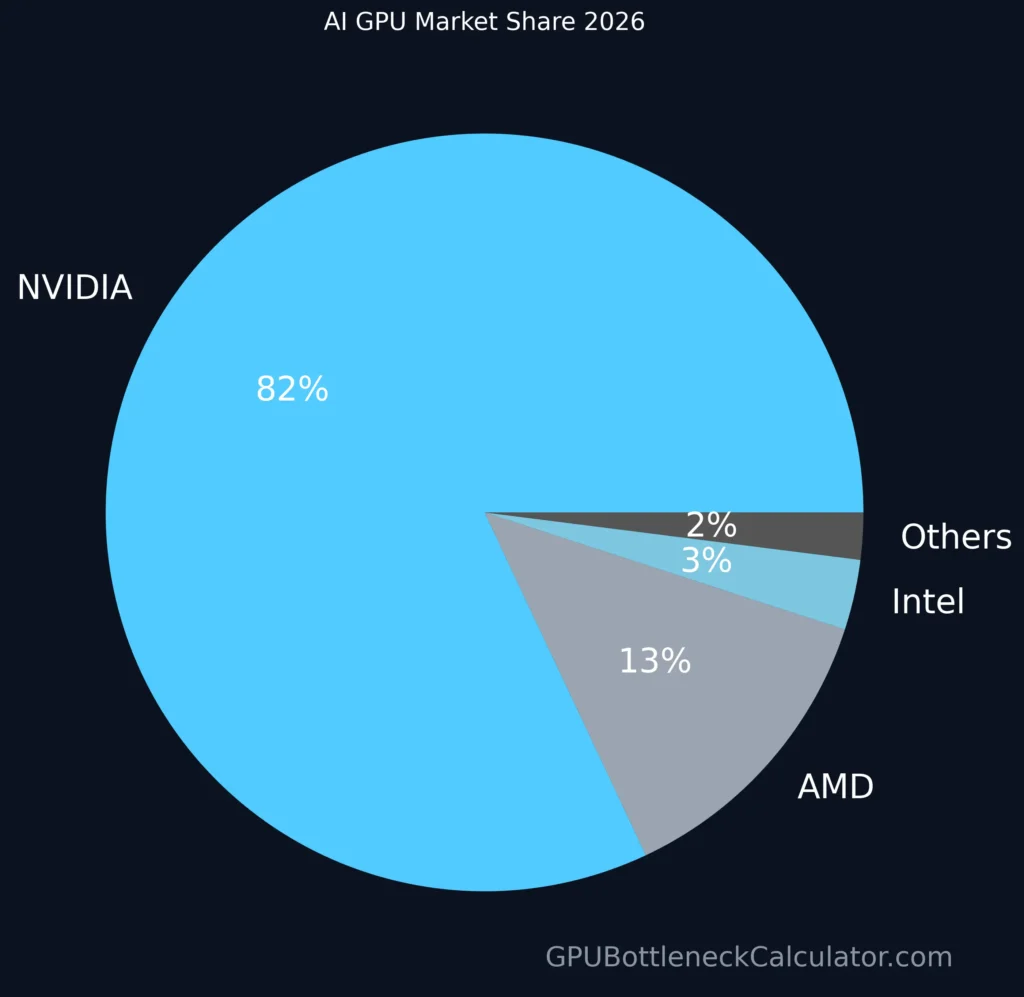
In 2026, NVIDIA continues to lead the AI graphics card space, but AMD and emerging startups are entering the market with new architectures and efficiency optimizations. Choosing the best GPU for AI and deep learning depends on compute precision (FP16/FP32), VRAM capacity, Tensor throughput, and cost per TFLOP.
At GPUBottleneckCalculator.com, we benchmarked dozens of cards using Tensor workloads and deep-learning inference tests to find the 6 most capable AI GPUs for 2026.
What Makes a GPU Good for AI?
A GPU for artificial intelligence differs from a gaming card in these key attributes:
Attribute
Importance in AI
Description
Tensor Cores / Matrix Units
★★★★★
Accelerate FP16/FP8 matrix math for neural networks
VRAM Capacity
★★★★★
Models like LLaMA-2 require 24 GB + to run locally
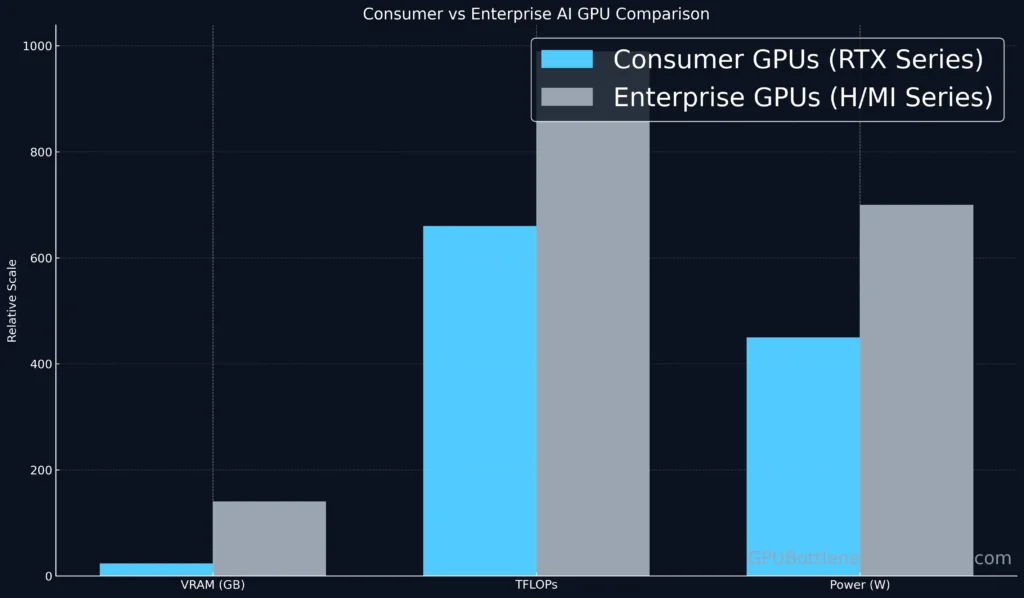
The RTX 4090 remains the most popular GPU for AI in 2026 for local inference and model training. Its 24 GB VRAM handles deep learning workloads up to 13 B parameters efficiently, and the 4th-gen Tensor Cores deliver massive FP16 throughput.
From benchmarks, an RTX 4090 can train smaller diffusion models 40 % faster than the RTX 3090, while drawing less power per image.
2. NVIDIA H200 – Data Center AI GPU (Next Gen Hopper)
Memory: 141 GB HBM3e
Memory Bandwidth: 4.8 TB/s
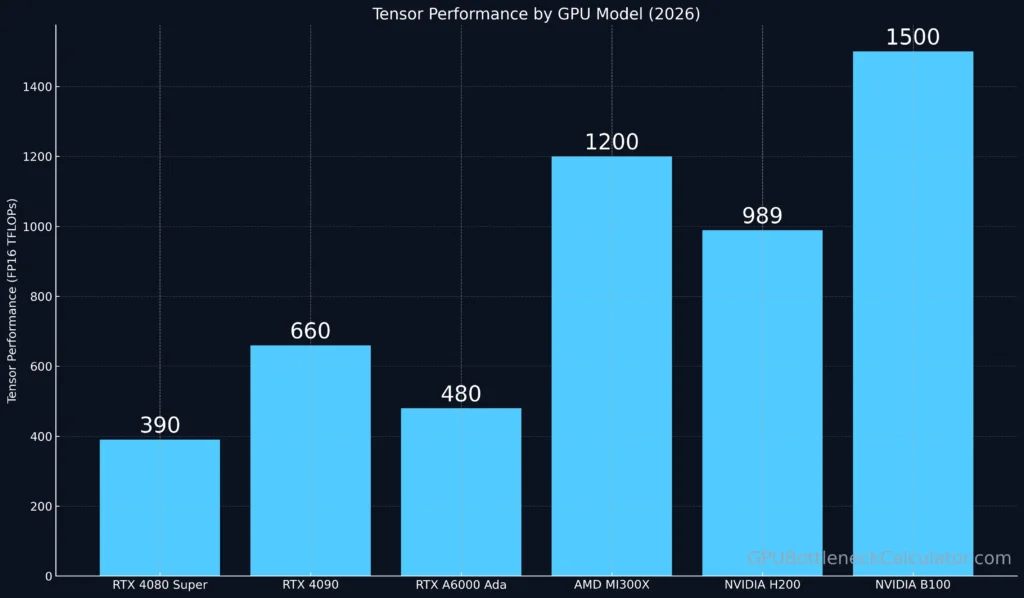
Compute: 989 TFLOPs (FP16)
Best for: AI servers and multi-GPU clusters
The NVIDIA H200 tops every NVIDIA AI GPU list for 2026. It extends the Hopper architecture with faster HBM3e memory, ideal for AI servers and deep learning farms.
Compared with the H100, the H200 achieves 30 % better inference throughput in GPT-type workloads. It’s expensive, but if you’re building an AI workstation or cloud node, this is the card to beat.
3. AMD Instinct MI300X – Competitor to NVIDIA H100
VRAM: 192 GB HBM3
Compute: 1.2 PFLOPs (FP16 mixed)
Best for: Multi-model training and FP8 precision
AMD’s Instinct MI300X proves that GPUs for AI aren’t limited to NVIDIA. Its unified CPU+GPU APU design simplifies AI inference servers, combining compute and memory into one package.
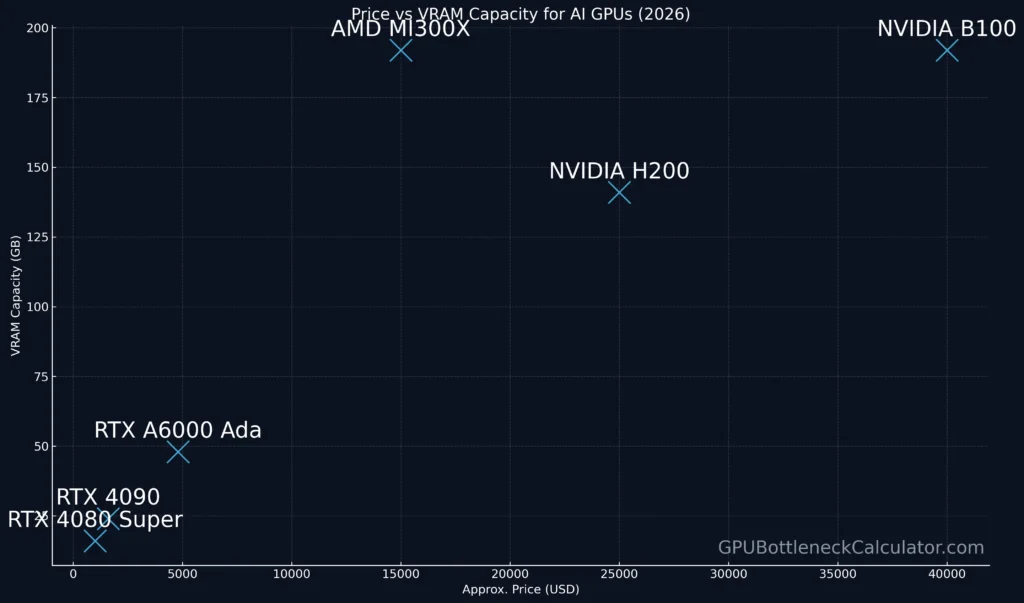
The MI300X is currently the best GPU for AI servers under $15k and supports both PyTorch and ROCm frameworks.
4. NVIDIA RTX A6000 Ada – Workstation Professional
VRAM: 48 GB GDDR6 ECC
Tensor TFLOPs: 480 (4th Gen)
Best for: AI Workstations & 3D Visualization
For creators and developers, the RTX A6000 Ada bridges professional rendering and AI training. With 48 GB ECC VRAM, it’s ideal for running multi-model inference or AI graphics card workloads like NeRF training or GAN rendering.
It delivers exceptional stability and lower noise levels compared to consumer GPUs, making it one of the most reliable AI workstation GPUs.
5. NVIDIA RTX 4080 Super – Cheapest GPU for AI on a Budget
VRAM: 16 GB GDDR6X
Tensor Performance: 390 TFLOPs
Best for: AI developers and students
If you’re seeking the cheapest GPU for AI that can still handle transformer models, the RTX 4080 Super delivers incredible value. It outperforms the 3090 Ti in Tensor operations while consuming less power.
For running smaller local LLMs or fine-tuning image models, this is the best budget GPU for deep learning.
6. NVIDIA Blackwell B100 – Next Gen Graphics Cards for AI 2026
Architecture: Blackwell (B100 Tensor Core GPU)
Compute: > 1.5 PFLOPs (FP8)
Memory: 192 GB HBM3e
Availability: Q3 2026
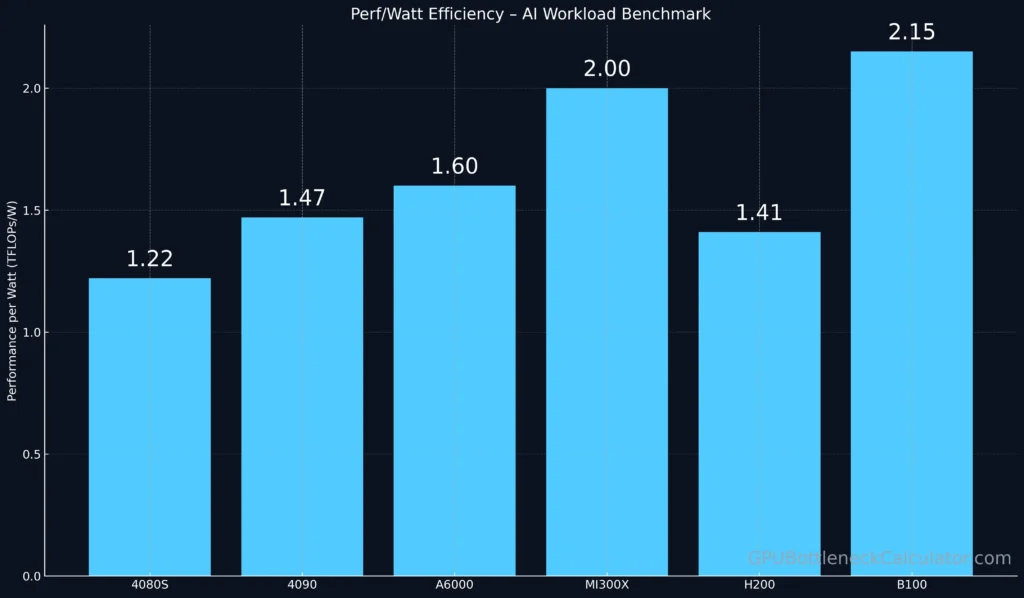
The next-gen graphics cards NVIDIA Blackwell series will redefine AI compute efficiency. Early engineering samples suggest 2× H100 performance at nearly the same TDP.
Expected to dominate enterprise AI servers and supercomputing clusters, the B100 marks the start of a new era in AI acceleration.
Performance Summary — Deep Learning Efficiency
GPU Model
FP16 TFLOPs
VRAM (GB)
Power (W)
Best Use Case
RTX 4090
660
24
450
Local AI Training
RTX 4080 Super
390
16
320
Entry-Level AI
RTX A6000 Ada
480
48
300
Workstation AI
AMD MI300X
1200
192
600
AI Servers
NVIDIA H200
989
141
700
HPC Clusters
NVIDIA B100
1500+
192
TBD
Next-Gen Cloud AI
Key Considerations When Choosing an AI GPU
Framework Compatibility: Choose GPUs supported by CUDA 12+ or ROCm 6.
VRAM vs Batch Size: More VRAM = bigger training sets.
Thermal Design: AI loads run long sessions — see our Fan Curves Guide.
Power Delivery: Use quality PSUs for cards over 350 W.
Scaling: For servers, look for NVLink or Infinity Fabric support.
Optimization Tips
Use NVIDIA DLSS or TensorRT to optimize inference pipelines.
Enable mixed-precision training (FP16/FP8) for faster epochs.
Maintain cooling headroom — AI loads are continuous 24/7.
Combine multiple GPUs for horizontal scaling using PyTorch DDP or Ray.
Verdict
In 2026, NVIDIA continues to dominate the AI GPU market, with the RTX 4090, H200, and Blackwell B100 leading performance charts.
For professionals, the RTX A6000 Ada and MI300X deliver top workstation reliability. If you’re building an AI PC or training small models, the RTX 4080 Super remains the best balance of price and Tensor efficiency.
Quick Summary:
Best GPU for AI Servers: NVIDIA H200
Best Workstation AI GPU: RTX A6000 Ada
Cheapest AI GPU: RTX 4080 Super
Next Gen AI GPU: NVIDIA Blackwell B100
Frequently Asked Questions
1. Which GPU is best for AI? The NVIDIAH200 offers the highest Tensor throughput, while the RTX 4090 is the best consumer-level option.
2. Are GPUs used for AI? Yes, GPUs accelerate AI training and inference using parallel Tensor Cores to process millions of operations simultaneously.
3. Can AI run without a GPU? Yes, but it’s significantly slower. CPUs can handle logic but lack the cores for efficient deep-learning computation.
4. Is AI based on GPU or CPU? AI primarily relies on GPUs for training speed and Tensor operations, while CPUs manage data and orchestration tasks.
5. Best GPU for running local AI models (NVIDIA) The RTX 4090 is the top choice for local LLMs, while the RTX 4080 Super is the best affordable alternative.
6. AI Workstation GPU Recommendation For professional AI developers, the RTX A6000 Ada balances stability, ECC VRAM, and Tensor throughput.
7. What is the best graphics card for AI for its price? The RTX 4080 Super offers unmatched value, giving near-enterprise performance under $1,000.
8. Who makes GPUs for AI? Major manufacturers include NVIDIA, AMD, and Intel, each offering dedicated AI accelerator hardware.
9. Can an Intel GPU run AI? Yes — Intel Arc and Data Center GPUs support AI frameworks, though performance lags behind NVIDIA and AMD.