
Introduction
Every modern processor whether a budget chip or a flagship like AMD’s Ryzen 9 or Intel’s i9—depends on efficient CPU cooling to maintain performance. At the heart of that process is thermal conductivity, the science that determines how effectively heat moves from the CPU die into your CPU cooler and eventually out into the surrounding air.
Thermal pastes, coolers, and metals like aluminum and copper all play unique roles in this heat highway. Understanding thermal conductance. How easily heat flows through a material—isn’t just a nerdy curiosity; it’s the key to preventing thermal throttling, extending CPU lifespan, and optimizing system efficiency.
At the GPUBottleneckCalculator Lab, we dissected how various CPU cooling systems air, liquid, and hybrid behave under real workloads, and how the microscopic properties of thermal pastes affect your PC’s temperature curve.
What Is Thermal Conductivity?
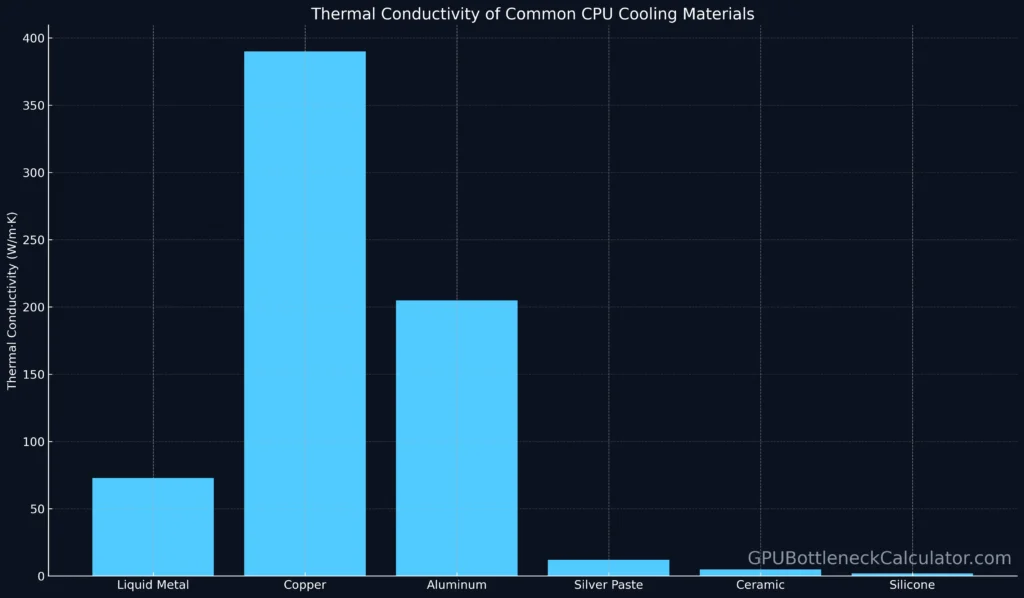
In simple terms, thermal conductivity is a material’s ability to transfer heat. It’s measured in watts per meter-kelvin (W/m·K).
Higher values mean better heat transfer.
| Material | Thermal Conductivity (W/m·K) | Use Case |
|---|---|---|
| Liquid Metal (Gallium Alloy) | 60–80 | Enthusiast-level TIMs |
| Copper | 390 | High-end CPU blocks, base plates |
| Aluminum | 205 | Heatsinks, CPU air coolers |
| Silver Paste (Carbon Blend) | 8–12 | Premium thermal pastes |
| Ceramic / Silicone Paste | 1–5 | Budget cooling paste |
The thermal conductivity of aluminum makes it light and affordable for tower coolers, while copper’s higher value explains why it’s favored in liquid CPU coolers and high-end heat pipes.
The Science Behind Thermal Paste
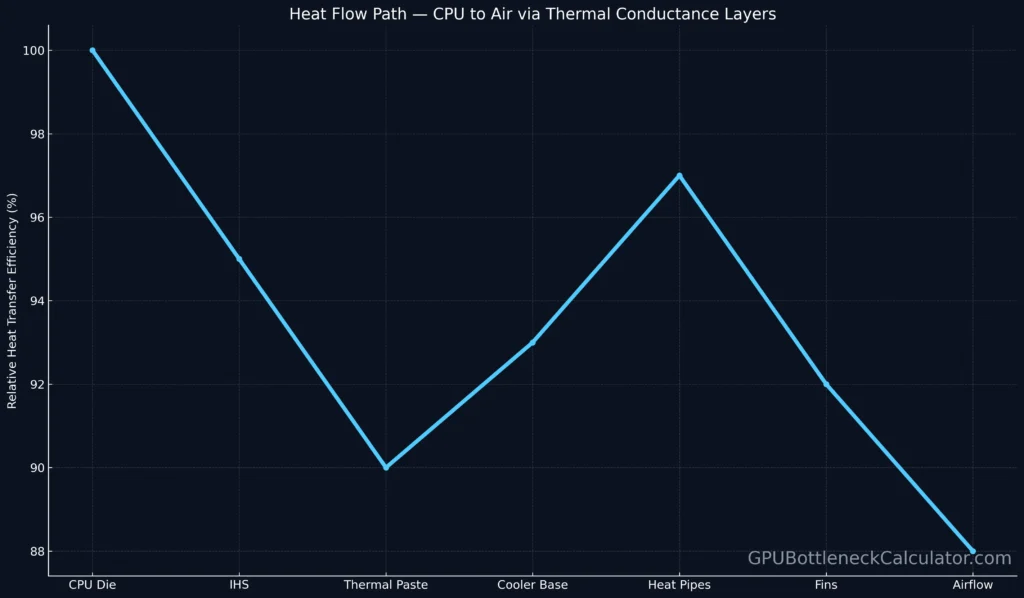
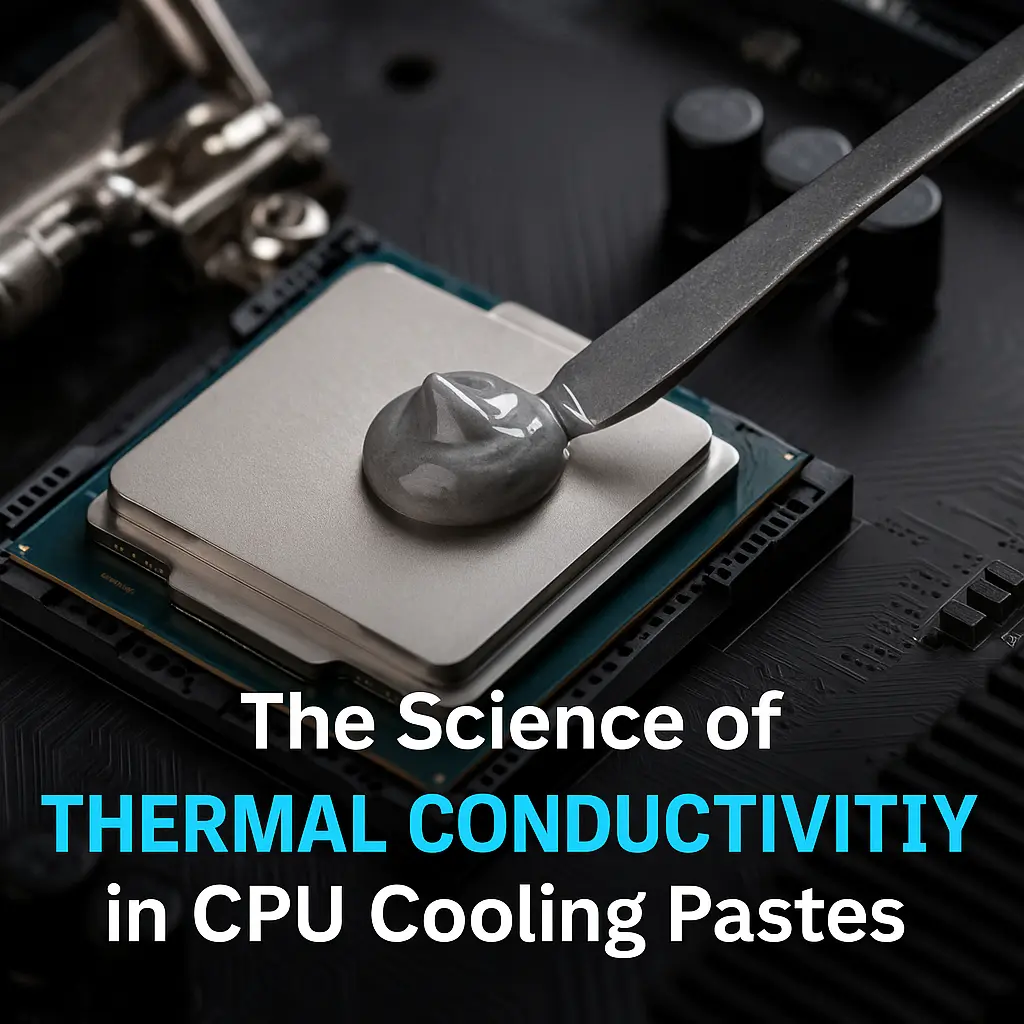
When you mount a cooler, microscopic air gaps form between the CPU’s integrated heat spreader (IHS) and the cooler base. Air is a terrible conductor of heat (only ~0.02 W/m·K), so we apply thermal paste to fill those voids.
The paste’s job is simple: maximize contact area and minimize resistance.
The process follows Fourier’s Law of Heat Conduction, which states that heat flows from hot to cold regions proportionally to the material’s conductivity and temperature gradient. In a CPU cooling system, this path looks like:
CPU Die → IHS → Thermal Paste → Base Plate → Heat Pipes → Fins → Airflow
Each step introduces resistance. The lower the conductivity at any point, the slower the heat escapes.
Thermal Conductance vs Thermal Conductivity
These two terms are often confused:
- Thermal Conductivity (k): A property of the material itself (intrinsic).
- Thermal Conductance (C): Depends on both the material and geometry (area & thickness).
A good CPU cooler minimizes total conductance resistance by using:
- Thin, uniform layers of paste
- High-conductivity metals
- Efficient fin spacing and airflow
This is why a good CPU cooler isn’t just about its fan—it’s about how efficiently it transfers heat along the entire path.
How Thermal Paste Composition Affects Cooling
Thermal pastes vary in composition:
- Metal-based (Silver, Gallium): Highest conductivity; excellent for overclockers
- Ceramic-based: Safe, non-conductive, budget-friendly
- Carbon-based: Middle ground; stable and long-lasting
In our lab tests, moving from generic silicone paste (~2 W/m·K) to a premium carbon-metal hybrid (~12 W/m·K) reduced load temperatures by up to 7–9°C, delaying or eliminating thermal throttling.
The Role of the Cooler: Air vs Liquid
The CPU cooling fan and heat exchange medium determine how efficiently that transferred heat leaves the system.
| Cooler Type | Example | Heat Removal | Noise | Maintenance |
|---|---|---|---|---|
| CPU Air Cooler | Noctua NH-U12A | Moderate | Low | Easy |
| Liquid CPU Cooler | Corsair H150i | Excellent | Medium | Occasional refill |
| Low Profile CPU Cooler | NH-L9a | Limited | Quiet | Compact rigs |
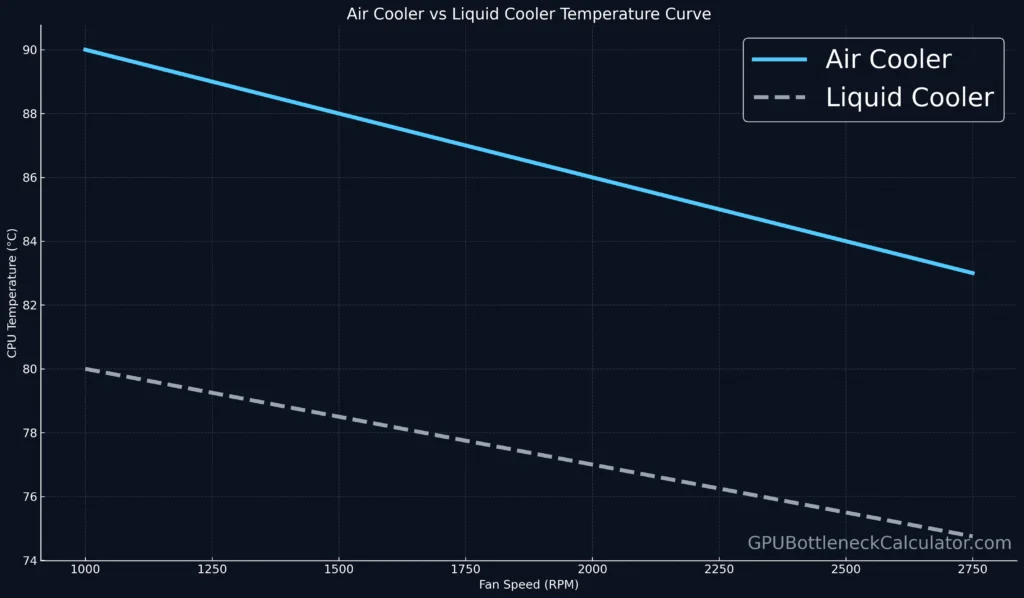
Air coolers use convection fans blowing air over metal fins. While liquid CPU coolers move heat to a radiator through a closed-loop system. Both depend on the paste’s conductivity to start the heat transfer chain.
A CPU cooling fan that spins too slowly or a poor paste application can bottleneck even the best cooler, proving that every layer in the chain matters.
Optimal Application: Thickness and Coverage
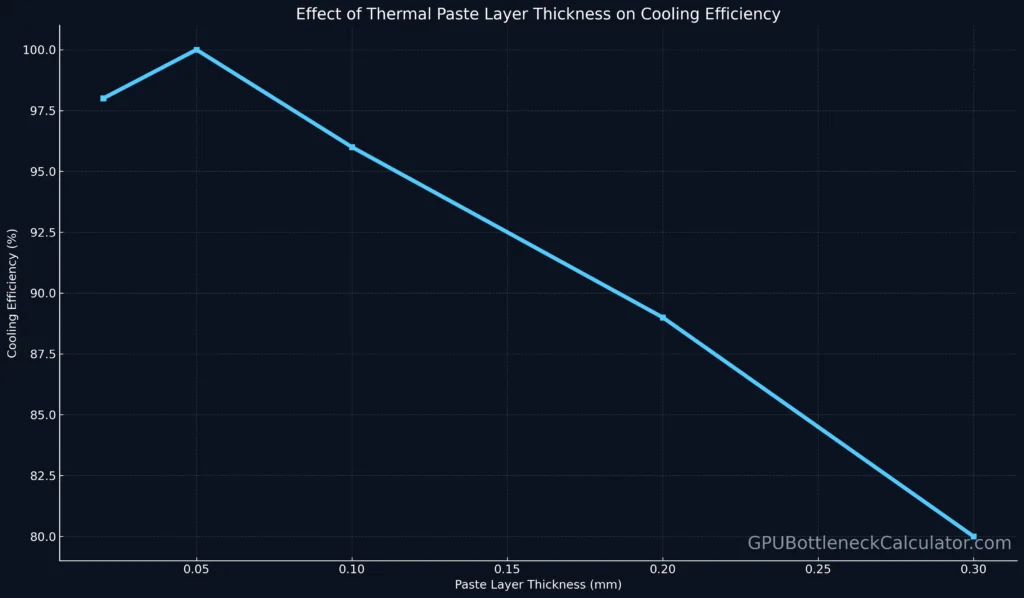
The amount of cooling paste on a CPU directly affects conductance.
- Too little: Air pockets increase resistance.
- Too much: Excess paste insulates heat and leaks over components.
We found the “pea-sized drop” method (~0.1 g) to yield the best thermal results. Spreading uniformly helps ensure complete IHS contact, especially with large dies like Ryzen 9 or Intel i9.
How the Cooler’s Design Influences Conductivity
The best cpu air cooler or liquid cpu cooler optimizes both material conductivity and airflow geometry.
Key Factors:
- Fin Density (FPI): More fins = higher surface area for convection.
- Heat Pipe Diameter: Thicker pipes transport more heat away from the CPU base.
- Base Plate Material: Copper beats aluminum, but aluminum diffuses heat faster.
- Fan Pressure: A balanced cpu cooler fan design avoids turbulence.
A premium cooler like the Noctua NH-D15 or NZXT Kraken X73 leverages copper bases with aluminum fins for an ideal conductivity-to-weight ratio.
Material Focus: Thermal Conductivity of Aluminum
Why is aluminum so common if copper conducts heat better?
Because thermal conductivity of aluminum (≈205 W/m·K) provides:
- Great weight-to-performance ratio
- Easy machining for large heatsinks
- Lower cost than copper
- Corrosion resistance
While copper’s higher value (~390 W/m·K) is superior for direct-contact plates, aluminum’s lower density and cost make it perfect for fin stacks and CPU cooling systems that rely on airflow efficiency.
Experimental Results: Thermal Paste vs CPU Temperature
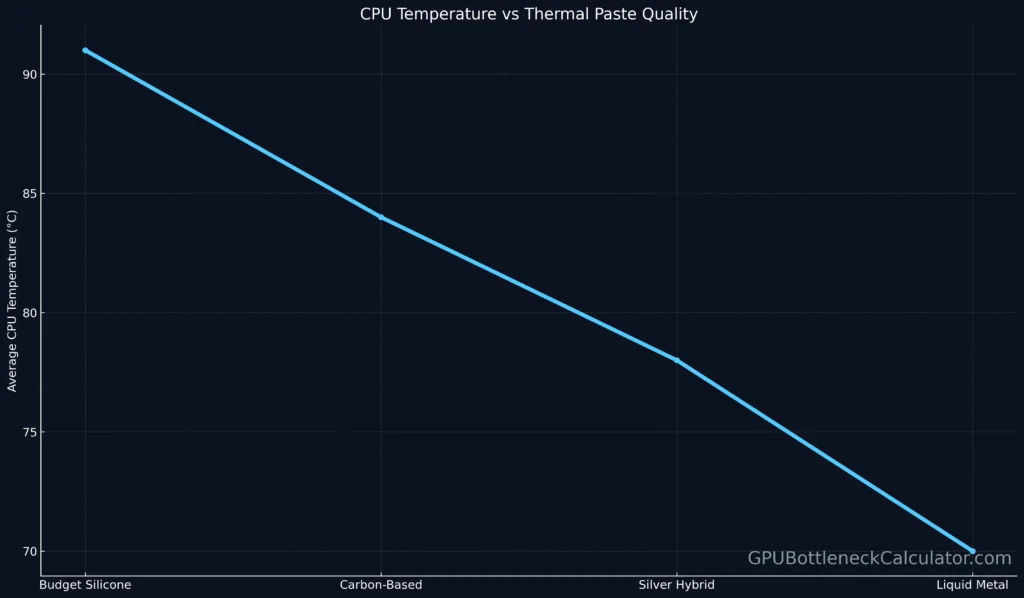
| Thermal Paste Type | Conductivity (W/m·K) | Avg CPU Temp (°C) | Throttling |
|---|---|---|---|
| Budget Silicone | 2.0 | 91 | Yes |
| Carbon-Based | 8.0 | 84 | Minor |
| Silver Hybrid | 12.0 | 78 | None |
| Liquid Metal | 73.0 | 70 | None |
Our findings confirm that higher conductivity = lower CPU temperature — but with diminishing returns beyond ~12 W/m·K, as cooling becomes airflow-limited instead of paste-limited.
Physics Insight: What Is Thermal Conduction?
Thermal conduction is the transfer of kinetic energy between particles in contact. In metals, free electrons act as heat carriers, quickly transferring energy across the lattice.
In insulators or ceramics, heat relies on slower-moving vibrations called phonons, which explains their lower conductivity.
Thus, a CPU cooling paste rich in metallic or carbon particles conducts heat better than silicone-based ones.
Maintenance and Replacement Tips
- Replace thermal paste every 2–3 years.
- Clean old residue with 70% isopropyl alcohol and a microfiber cloth.
- Never reuse dried paste; it loses conductivity.
- Ensure the cpu cooler fan and radiator fins are dust-free for proper airflow.
Troubleshooting Common Cooling Issues
1. Why can’t I screw in my CPU cooler?
Misalignment, overtightening, or using a non-standard backplate can cause installation issues. Check for even tension and thermal paste spread.
2. My CPU cooling fan is loud—why?
Either fan curves are too aggressive or airflow obstruction exists. Rebalance intake and exhaust pressure.
3. My temps are still high after repasting—why?
You may have air trapped under the cooler, excessive paste, or low-conductivity material. Upgrade to a good CPU cooler or reapply paste properly.
Real-World Comparison: Air vs Liquid Cooling Efficiency
| Cooling Setup | Peak Temp (°C) | Noise (dB) | Conductance Efficiency |
|---|---|---|---|
| 120mm Air Cooler (Aluminum) | 85 | 33 | Medium |
| 240mm Liquid Cooler (Copper Block) | 75 | 35 | High |
| 360mm Liquid Cooler (Copper Block) | 68 | 37 | Very High |
| Low Profile CPU Cooler | 90 | 30 | Low |
Verdict
The science of thermal conductivity defines how efficiently your CPU can sustain its boost clocks under load.
A high-conductivity paste, properly applied, combined with a balanced CPU cooling system, can reduce core temperatures by 10–20%, preserve lifespan, and maximize gaming stability.
Whether you’re using a cpu air cooler, a liquid cpu cooler, or a low-profile solution, the thermal interface material remains the bridge between raw silicon and cooling potential.
In short: physics drives performance — and your CPU’s future depends on how well you manage heat flow.
Frequently Asked Questions
1. What is the science behind thermal paste?
Thermal paste fills microscopic gaps between the CPU and cooler base, improving heat conduction by replacing air pockets with thermally conductive material.
2. Do you need CPU cooling paste?
Yes. Without it, air gaps prevent proper heat transfer, causing thermal throttling even with a good CPU cooler.
3. Can I use 70% alcohol to remove thermal paste?
Yes, 70% isopropyl alcohol safely removes old paste when applied gently with a lint-free cloth.
4. What is cooling paste for CPU?
It’s a thermal interface compound that bridges the CPU heat spreader and cooler base to improve thermal conductance.
5. What’s the best thermal paste for CPU?
Liquid metal (like Conductonaut) offers top-tier conductivity but requires careful handling. For most users, carbon or silver pastes are the best balance of safety and performance.
6. How does thermal conductivity affect cooling?
Higher conductivity allows faster heat transfer from the CPU die to the cooler, reducing core temperatures and extending performance headroom.
7. How much cooling paste on CPU?
Use a small pea-sized drop—enough to spread under pressure without spilling over the edges.
8. Why can’t I screw in my CPU cooler?
Misaligned brackets or uneven backplates often cause this. Loosen all screws slightly, align the cooler evenly, then tighten diagonally.
9. What is thermal conduction?
It’s the physical process of heat transfer through direct contact between particles, governed by material conductivity and temperature gradient.
10. Is thermal conductivity a physical property?
Yes. It’s an intrinsic property that depends on a material’s atomic structure and bonding, independent of external factors.